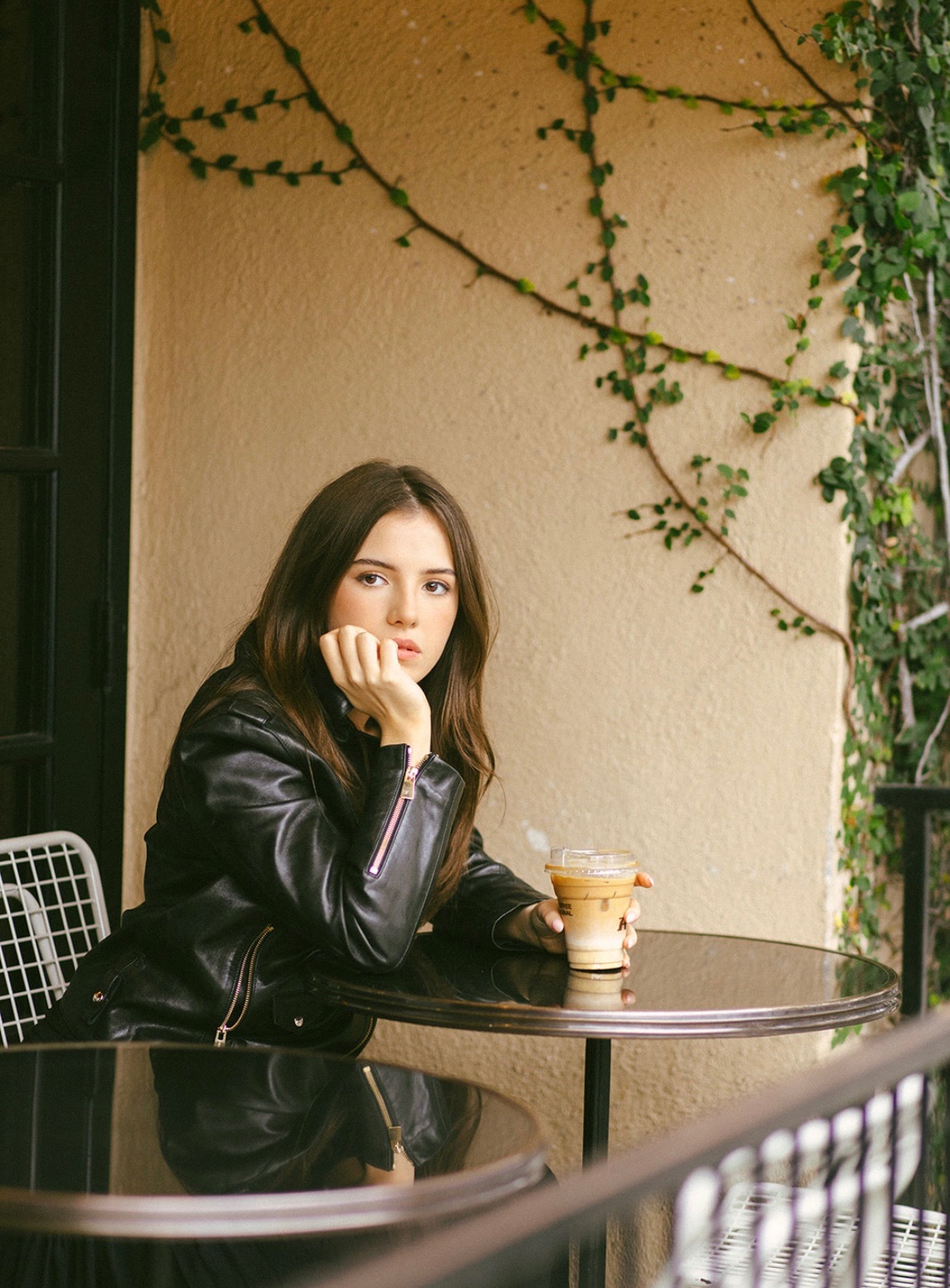

Coco Coloma does not introduce herself with her age. Not because she is hiding it, but because it is rarely the most interesting thing about her. At 16, she is already moving between acting, writing, and directing with the focus of someone far older, yet she speaks about storytelling with the urgency of someone who has always known it was essential.
“I’ve always been an actor,” she says simply. “I actually started in a play when I was four, it was kind of mandatory because there weren’t a lot of students and they needed people, but I ended up having so much fun that I just kept doing it.” What began as circumstance quickly became identity. “I continued doing plays, making little short films with my friends, and I realized how much I loved being part of that world.”
Coloma grew up immersed in film culture. “I’ve also been surrounded by filmmakers my whole life, and my parents definitely influenced me a lot since they’re both filmmakers,” she explains. “Being around that environment has always just made being in this industry seem so fun and possible.” For her, Hollywood was never a distant fantasy, it was tangible, textured, something she could reach.
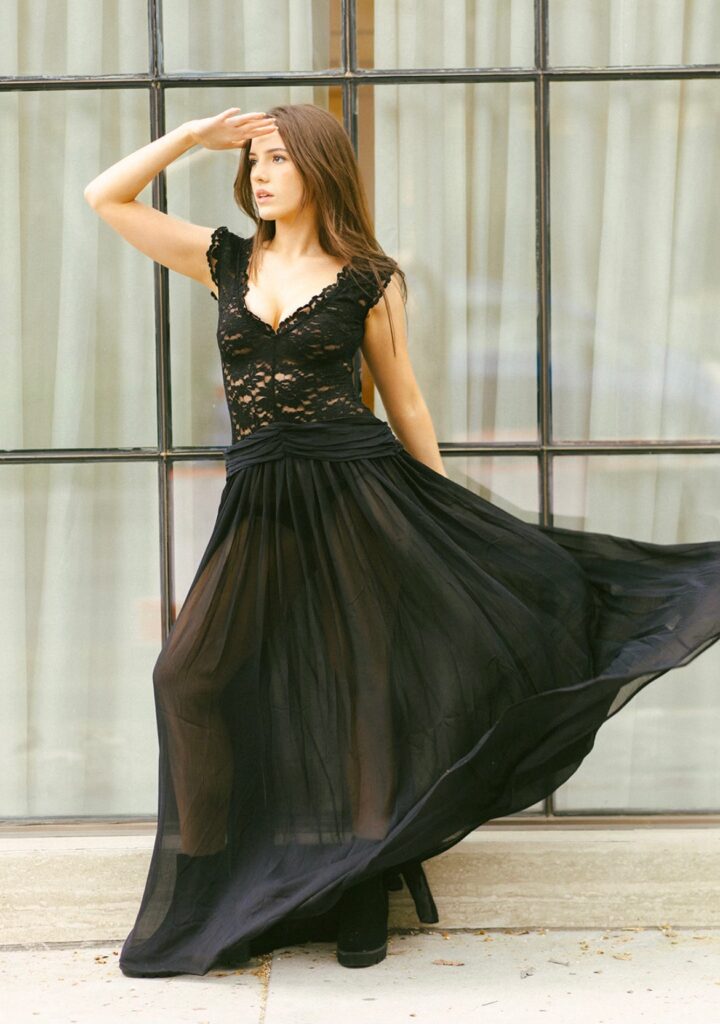
Still, proximity did not erase the work. She trained in the Margie Haber 12 Week Teen On Camera Acting Intensive, studied improv, and pursued ongoing classes, alongside intensive scene study with Tamra Meskimen. The discipline reflects how seriously she takes the craft. Loving storytelling was never enough, she wanted to understand it.
That commitment extends beyond performance. In the upcoming feature Or Else, currently in post production, Coloma steps into one of her first major screen roles. Yet acting is only part of her creative architecture. Writing and directing are not side projects, they are parallel languages she continues to master.
“To me, it all feels very intertwined,” she says of balancing the three roles. “As a writer, I’ve learned how formatting and structure actually carry meaning, and as a director, I’ve learned how certain shots create specific emotions and reactions for the audience.” That expanded perspective feeds directly back into her acting. “It almost feels like learning a different language. Through directing and writing, I’ve started to understand that language better, and it helps me analyze scripts more deeply and grasp characters more quickly when I step into a role.”
Her award winning television pilot, Something Old and Something New, has collected recognition from festivals around the world. The story follows two women, one a single author in her 30s who sees romance and family as “settling for less,” the other a young woman from the 1800s who believes love and marriage are everything. They switch bodies and are forced to confront the limits of their assumptions.
“I think what’s most personal to me about Something Old and Something New is that I feel like I grew up in a society that often lacks empathy and real understanding,” Coloma explains. “They both heavily judge each other, until they switch bodies and they realize that life isn’t what it looks like from the outside and that it’s easy to judge someone without really understanding their point of view.” At its core, she says, “the story is about how there isn’t one right way to live, and how different opinions and experiences can both be valid.”
The idea connects to her own adolescence in the age of constant comparison. “Growing up around social media and the entertainment industry, it’s really easy to compare your life to other people’s and assume theirs must be better,” she says. “My mom always used to say ‘the grass is greener’ and I didn’t fully understand that until I started writing stories like this.” Body switching became a narrative device for empathy. “When two characters actually live each other’s lives, they realize it’s never exactly what they imagined.”
Her instincts tend toward genres that provoke reaction. “I usually gravitate toward horror and comedy because they’re both genres that really make you feel something,” she says. “They’re very reaction based.” Horror allows her to explore humanity through unease, “almost like symbolism,” while comedy softens and connects. For coming of age stories in particular, she leans into experience. “People always say ‘write what you know.’ It’s not like I live in The Shining, but I do understand a lot of coming of age topics because of where I am in my life.”
That sense of urgency about self expression is rooted in earlier insecurity. “When I was like 11 or 12 I was really really insecure and I was like the funny friend that would make fun of themselves to get people to laugh,” she recalls. “I was always trying to filter what I said or did.” Acting and writing became liberation. “It was one of the only places where I felt like I could just go all in, be creative, be emotional, be weird, be whatever I wanted, and not hold back. And at the time I remember being like this is definitely what I need to do.”
Her short film Out Cold marked her first experience directing, a psychological horror story about a mortuary assistant who discovers a presumed dead 13 year old girl has awakened mid preparation. The film has not yet been widely seen, but the impact on Coloma is clear.
“One of the things that really changed my perspective in making Out Cold is just to go for it,” she says. “Directing used to feel so impossible and foreign to me. I never pictured myself as a director because it felt like something I wasn’t capable of.” The act of stepping behind the camera forced a reckoning. “A lot of the things that feel the scariest are kind of like skydiving, you have to jump out of the plane and go for it.”
That philosophy connects directly to the best advice she has ever received. “If something feels uncomfortable or really hard to do, it usually because I just don’t know enough about it, and I need to learn more,” she says. “Once I research, practice, and really understand what I’m doing, it suddenly feels much easier. That’s when I’m able to relax and just be the artist.”
Coloma is equally clear about what she hopes to contribute to the industry. “I stay true to myself in an industry that likes to label people early by making films that question labels,” she says. She is drawn to “underappreciated people, unusual jobs, and unique positions in life,” recently writing a script about “a girl who plays a mermaid at children’s parties.” For her, that specificity is the point. “I want to make more films about underappreciated people,” she adds. “As an actor, I’m most interested in playing people who aren’t ‘typical,’ characters who are a little unexpected, a little strange.”
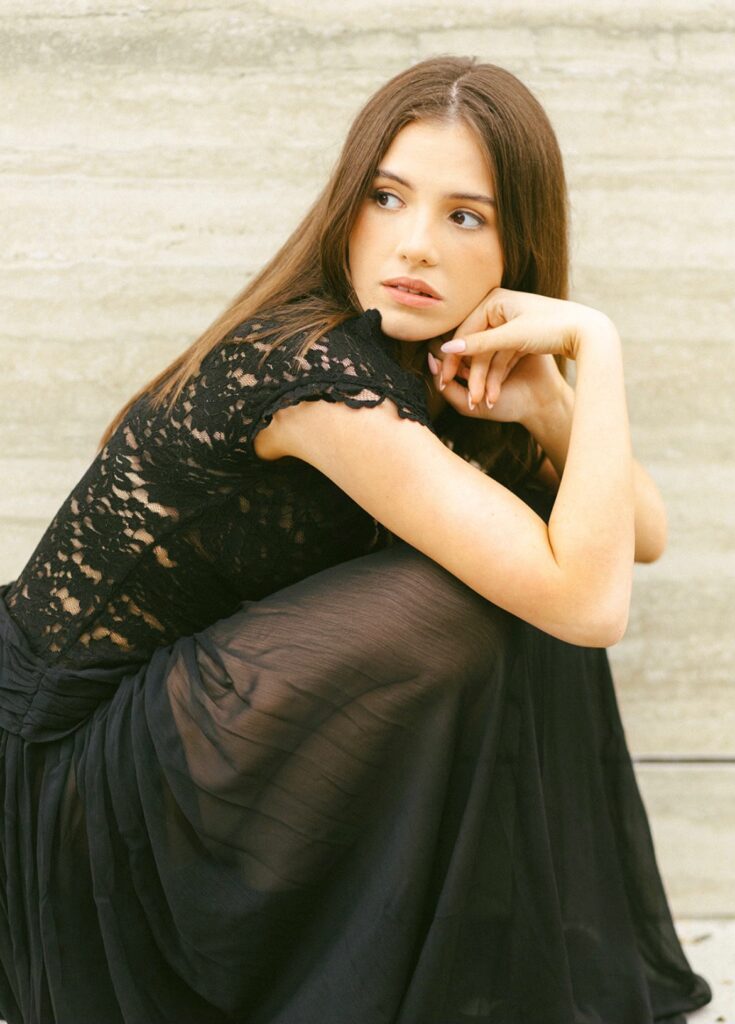
When asked whose career she admires, she lights up. “I recently rewatched The Substance and I just think Margaret Qualley is absolutely killing it right now,” she says. “She’s just one of those actors who can really play anything.” Her list of idols stretches from “Meryl Streep, Angela Bassett, and Sandra Oh” to Kathy Bates, whose performance in Misery she calls “so incredible to me, it really feels like two different people.” What she reveres most are actors who are “fearless in storytelling, people who aren’t shy or apologetic.”
That fearlessness extends to her advice for other young creatives. “It’s okay to make shitty projects,” she says candidly. “Allowing yourself to just create and not constantly trying to figure out what other people are going to like or think.” Especially at the beginning, she believes, “the best way to learn is by doing. But really at all stages risk it being complete shit.” She points to the current independent wave as inspiration. “Don’t be shocking just to be shocking, but if something feels authentic to you and you love it, take the risk of it being horrible and just make it.”
For Coloma, the through line is not age, nor genre, nor even medium. It is perspective. “Film is my life, and I want to create beautiful stories that leave an impact on people,” she says. She also resists the idea that art belongs to a specific stage of life. “I also don’t believe there is a ‘right’ age to make art.”
At 16, Coco Coloma is not asking permission to take up space. She is studying, experimenting, jumping out of planes, and building worlds. And she is doing it on her own terms.