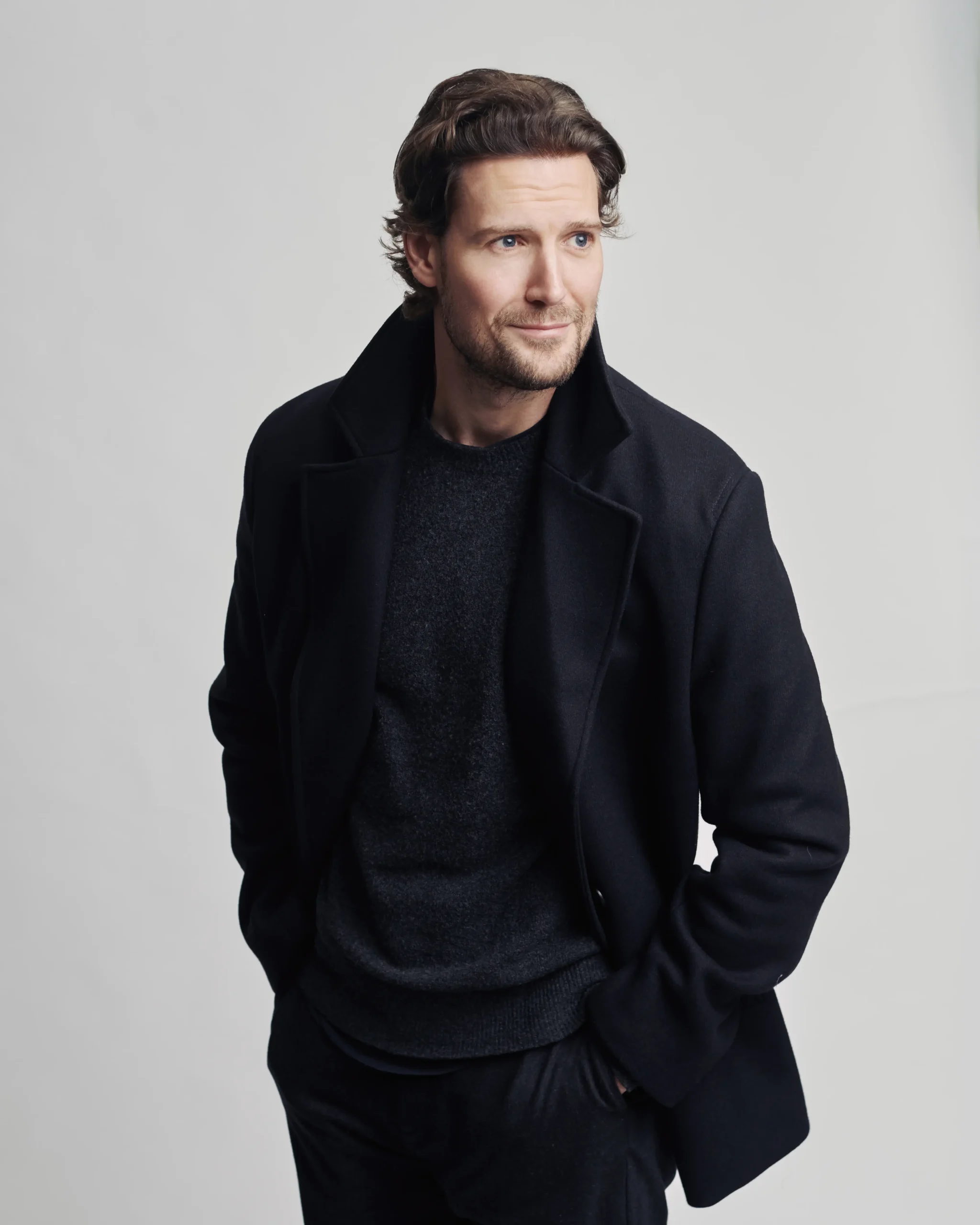

In an industry that often anoints new stars overnight, Alexander Johnson is emerging in a more traditional way, through a steady accumulation of serious work with ambitious filmmakers. The British actor, whose imposing 6’4” frame and quietly assured screen presence recall a classic leading-man archetype, is beginning to appear in a slate of high-profile international films that have already started to attract attention across the festival circuit. If his name isn’t widely known yet, it’s increasingly one that casting directors, filmmakers, and festival audiences are starting to notice.
Johnson’s path to the screen was less meteoric rise than deliberate build. A lifelong student of cinema, he describes himself as a “movie geek” who grew up watching films obsessively, his interest in acting developed after exposure to performing arts opened a creative avenue he hadn’t initially planned to pursue. What followed was a long period of persistence: working, training, and absorbing the craft while waiting for the right opportunities to appear.
That patience is now beginning to pay off with a run of projects that place him alongside major filmmakers and actors working at the intersection of prestige international cinema and politically minded storytelling.
Among the most anticipated is The Wizard of the Kremlin, the sweeping political drama directed by Olivier Assayas and based on Giuliano da Empoli’s bestselling novel. The film explores the rise of Vladimir Putin through the eyes of a fictional political strategist navigating the volatile power struggles of post-Soviet Russia. Featuring an ensemble cast that includes Jude Law, Paul Dano, Alicia Vikander, and Jeffrey Wright, the film blends historical drama with dark political satire and has already generated significant attention for Law’s transformation into the Russian leader.
For actors within such a production, the experience can be as valuable off camera as on it. Johnson has spoken about the importance of working around strong directors and seasoned performers, viewing each project as an opportunity to sharpen his own craft.
“Being around great actors and great crews raises your level,” he has said. “You learn just by observing how they approach the work.”
Another project drawing attention is The Chronology of Water, the long-awaited directorial debut from Kristen Stewart. Adapted from Lidia Yuknavitch’s acclaimed memoir, the film offers a visceral portrait of a woman navigating trauma, addiction, and artistic reinvention. Stewart’s film has been widely discussed for its striking visual language and the emotionally raw central performance by Imogen Poots, positioning it as one of the more daring literary adaptations to reach the festival circuit in recent years.
Johnson views projects like these as part of an ongoing education in filmmaking.
“Every set is a chance to learn,” he says. “You see how directors solve problems, how actors build characters, how a film comes together piece by piece.”
He also appears in Out of This World, an English-language drama from Spanish auteur Albert Serra, known for visually distinctive films that blur the line between historical narrative and philosophical allegory. The project marks Serra’s move into English-language filmmaking and has drawn attention for its ambitious scope and evolving ensemble cast.
Taken together, the projects form a portfolio that suggests a particular trajectory: an actor drawn to sophisticated, internationally minded films rather than conventional studio fare. Johnson gravitates toward directors who explore power, psychology, and moral ambiguity, territory that aligns with the kinds of grounded, controlled characters he finds most compelling to play.
“I’m interested in characters who have a sense of competence and calm under pressure,” he says. “People who think before they act.”
It’s a sensibility that feels well suited to the kind of filmmaking that often begins on the festival circuit before expanding to wider audiences. Many actors who go on to major careers first appear in exactly this kind of environment—supporting roles in serious films that gradually build visibility among directors and producers.
Johnson appears to be entering that stage now.
For the actor, however, the goal is not a sudden breakthrough but longevity. The films currently emerging onto the international stage represent the early chapters of what he hopes will be a decades-long career.
“The dream is to keep doing this for a long time,” he says. “To keep learning and improving with every film.”
If the current wave of projects is any indication, Alexander Johnson may soon be one of those actors whose name audiences begin hearing more and more often, an emerging presence in the next generation of international cinema.